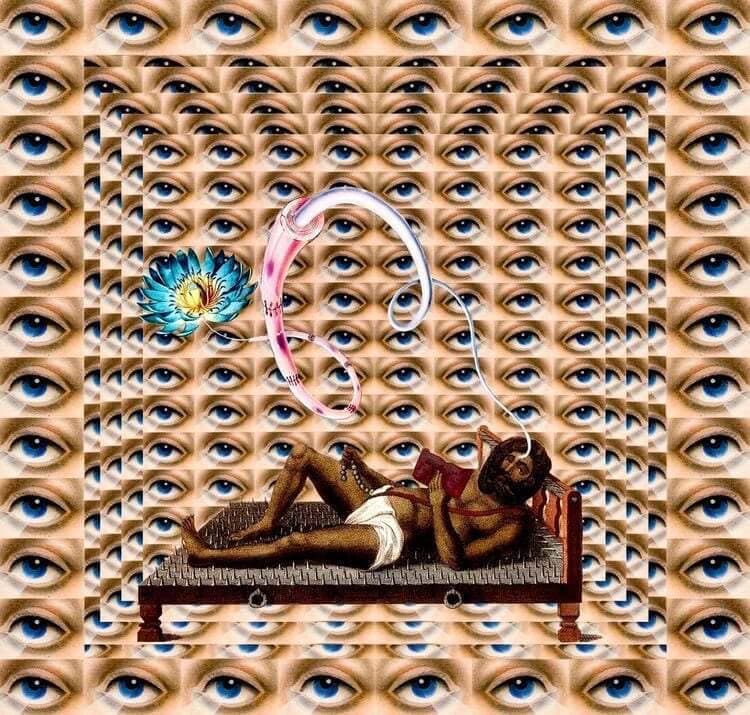
Now, it should be noted that God is perhaps the most mysterious aspect of spirituality. Trying to talk about God is like trying to utter the unutterable. It's like trying to convey the taste of ghee when we haven't really even tasted ghee. You know, ghee — the clarified butter. If somebody asks you, "What does ghee taste like?" — what are you going to say? Let's assume that they've never tasted ghee before and they ask you, "What does ghee taste like?" Well, you'll say, "Um, it tastes like ghee." The problem with God is that God can't be compared to anything. There's no language that could adequately describe God. God, being after all, that which is beyond all language, time, space, etc.
So, whether or not God exists...
- If God exists, then God is not something that we can really speak about or understand.
- God already is a mystery.
- God's very existence is a mystery.
- Even if we accept prima facie the existence of God, the nature of that existence is tremendously mysterious, inscrutable.
What to say of that same inscrutable, unutterable God manifesting in historicity as a — whoa. Okay, hold up. Now that sounds weirdly culty to say — that any individual, any person, for that person to claim that they are God. Hold up! Either that means we have no understanding at all about what God is, and that's probably true in every case, or that God is just the kind of thing that from time to time can appear as a person in history.
And so, in Christianity, the idea is that this Incarnation is limited to only one person. So, the Christ is uniquely an instantiation of God coming down to earth as a person, as a fellow. But we find this Incarnation idea actually kind of expounded and developed and articulated long before the Christ. And that isn't to say the Christ isn't an Incarnation. I think every Hindu, most of them at least — except those ones who are maybe still reeling from the trauma of their perceived colonization. Some people are still mentally colonized, I think, so they feel this weird aversion to all things Islamic and Christian. That's fine, that we can't begrudge them that; the history there is rather traumatic, and maybe those scars haven't yet fully healed in some of us.
And so some Indians maybe don't, but I think a vast majority of Indians, when we think about the Buddha or we think about the Christ, they'll say, "Yeah, yeah, these were incarnations, avataras," because the notion of an avatara, the notion of an Incarnation, is not at all unique to Christianity. It existed in India in the form of the Bhagavad Gita centuries, if not millennia, before the Christ. So yes, I think most Hindus will understand the Christ as an Incarnation. They just will be, I think, reticent to admit that he's the only incarnation because we find in Bhagavad Gita, Chapter 4, Verse 7, there's this beautiful verse, and there in Bhagavad Gita 4:7 we find Krishna telling Arjuna that from time to time:
Yada yada hi dharmasya glanir bhavati bharata Abhythanamadharmasya tadatmanam srjamy aham || 7||
"Whenever there is a disturbance in Dharma, and an increase in Adharma, I incarnate on this Earth, O Arjuna!"
The idea here is that if an Incarnation comes to teach us the right way, then the Incarnation most likely must come more than once and give us the teaching in different ways each time suited to that particular culture with its unique needs and problems.
Naturally, since Hindus are already familiar with Rama and Krishna as Incarnations, it's easy for them to accept Buddha and Jesus as Incarnations too.
What Makes an Avatar?
But hang on a moment. What makes an Incarnation an Incarnation? What stops a person from—in their very valid guru bhakti (devotion to their personal teacher)—attributing "avatar-hood" to their respective teachers if indeed there are many avatars?
In this post, we attempt to triangulate on the profound mystery of the Avatar from a non-dual point of view. How can a truly non-dual philosophy which holds that God is Consciousness (i.e., You), and as such, is non-different from the world, accommodate an Avatar doctrine?
In the course of doing that, we take a tour down the annals of history to pick out a few key teachings from a few avatars to implement in our own spiritual lives. The central thrust of this post is that the most important thing about an avatar is not necessarily the avatar but the message!
Here's what we are covering:
- God as a person in history?! Say what now?! (Bhagavad Gita and the Hindu notion of God's incarnations)
- Can you justify an avatar within a non-dual (advaitic) framework?
- Can Guru Bhakti lead to exaggerated claims about a saint's spiritual status? Who can determine that an avatar is indeed that and not just a great saint? And how to avoid "my avatar vs. your avatar" kind of thinking.
- A little aside on why Christmas is so special for our community—The Harmony of All Religions compared to Ice Cream and Music!
- The story of the founding of the Ramakrishna Mission and its connection to Christ (also the story of how our online community came about).
- What is (and what is the purpose of) an avatar? (vs. bodhisattvas/perfected souls, etc.)
- The phenomenon of an avatar from a non-dual point of view (an aside on the non-dual teachings of the Upanishads).
- Why do I suffer and how to overcome it? (as per the Upanishadic teaching sketched above).
- The Princess of Kashi Story.
- So what does the avatar have to do with this Upanishadic knowledge? (the contributions of Krishna and Buddha).
- The Contribution of Shankara and Chaitanya.
- How to Account for an avatar in the Non-Dual Tantrik View? The "Play Theory."
God's Incarnations: Restoring Dharma
So, in Christianity, the idea that God came down in the form of Jesus is that this Incarnation is limited to only one person. Christ is uniquely an instantiation of God coming down to earth as a person. We find this Incarnation idea actually kind of expounded, developed, and articulated long before Christ. That isn't to say that Christ isn't an Incarnation. Most Hindus, when they think about the Buddha or Christ, will say, "Yeah, yeah, these were incarnations, avataras. The notion of an avatara, the notion of an Incarnation, is not at all unique to Christianity. It existed in India in the form of the Bhagavad Gita centuries, if not millennia, before Christ. I think most Hindus will understand Christ as an Incarnation; they'll just be reticent to admit that he's the only Incarnation.
- Generally speaking, Rama is considered to be an avatara. God, the inscrutable, unutterable God, became Rama for the express purpose of restoring Dharma.
- In Rama's time, it was killing this particular egregious king named Ravana.
- Rama's purpose was to restore Dharma by killing Ravana.
- Then Krishna came.
- Krishna’s purpose expressly was to restore Dharma.
- But in Krishna's case, it was not just demon slaying, as per Rama’s case. It was also, actually, teaching.
- We don't have actually much from Rama in terms of teaching.
- We have his life, and we study his life from great authors like Tulsidas and various others who compose hymns about Rama and about Hanuman and about Sita, and all that.
- It's there, but we don't actually know very much about what he taught and what his philosophy was.
Not so with Krishna. Krishna took the time to expound a philosophy that was recorded as the Gita and now handed down and recited all throughout the centuries. So, the Gita is maybe the first instance of an avatar, of an Incarnation, teaching us something.
Now, after Krishna, we get Buddha, and Buddha clearly taught us something.
- The Buddha gave many, many, many lectures; it wasn't just like one Gita.
- I mean, Krishna... Many Gitas are attributed to him; it's not just the Bhagavad Gita. There is also the Shanti Gita, but anyway…
- Let's assume Krishna, his greatest contribution was the Gita.
- Then it seems quite clear that Krishna might have been the first avatara to teach something, so we have this Gita, this text.
- Then, after him, the Buddha went much further than just a single Gita. The Buddha gave lecture after lecture after lecture.
- He established—in perhaps one of India's first organized monastic communities—he established a religion, which I don't think Krishna ever set out to do.
- Rama never set out to establish a religion. Neither did Krishna. He was just teaching the teachings of the Upanishads in the Gita, but it was Buddha who first set up the infrastructure for what would be an institutionalized approach to—maybe not religion—but spirituality.
So, after the Buddha we had two others, actually lesser known:
- Shankara
- taught Advaita Vedanta
- Chaitanya
- taught the path of the heart called bhakti yoga primarily in the form of chanting—chanting the name of the Lord.
These are all incarnations of God. Christ—and this is important for today's topic—is seen as one of those incarnations of God. So, it's Rama, Krishna, Buddha, Chaitanya, you know, but also importantly, after the Buddha, Christ, and most importantly—as we argue—Ramakrishna is the most recent update in the software, if you will.
So, interestingly, each of them appeared for a unique message that more or less, generally speaking, is the same but tailored to the needs of their particular cultural milieu or their epoch. So, of course, what the Buddha taught at his time is radically different from what the Christ taught during his time because the audience was different. Knowing your audience is actually very important. The same truth can be packaged differently to meet the needs of that particular audience in that particular moment in time. And that's what the Avatar does. The Avatar gives the same truth—the truth is, after all, only one—gives that same truth over and over and over again in a way that we, you know, ignorant, erring humans as we are, can understand it.
What is God Doing Coming Down as a Person?
The idea of God is already quite mysterious. Whether or not She exists is uncertain. If She exists, the nature of that God is equally enigmatic. To claim that this God—unutterable and inexpressible as She is—comes as a human is a significant assertion, warranting detailed explanation.
Today's discussion will focus on the concept of an avatar. What exactly is an avatar? It is easy to accept this on faith, but I believe that doing so can be dangerous. One might say, "Why not? There is more to heaven and earth than is spoken of in your philosophy, Horatio." While I may concede that God could come as a person, it is essential to recognize the magnitude of this claim. We should not be too quick to accept it without question. We must ask:
- What does it mean for God to come as a person?
- What are the implications for me?
This is a substantial question that deserves our consideration.
The idea of an avatar is often accepted without question, even within a dualistic framework. In this view, if God is separate from God's creation, then from time to time, creation may need intervention. God, standing outside creation, might incarnate as an avatar to rectify issues. This perspective works within a dualistic framework, but it does not align with the non-dual tradition we follow. In our tradition and community, we hold that God is not separate from creation. Moreover, we assert that you are God.
You Are God
In fact, I can prove it to you here and now. I can show you that there is no such thing as God apart from the Consciousness that you feel yourself to be right now. When I say, "You are God," I don't mean "you," the body. I don't mean "you," the mind. I mean "you" in a way that you might have not considered yourself to be, before. I mean you as pure non-dual Consciousness. That is God.
That non-dual Consciousness is not only outside time, space, and causality, as God is indeed outside time, space, and causality, but that one non-dual Consciousness is wholly immanent in the world. The world is not separate from God. The world is God, and everything is God, and everyone is God.
What About the Avatar in a Non-Dual Model?
So then what to say of the Avatar, right? The Avatar doctrine makes sense in a dualistic model: if God is separate from her creation. But what about within the context of a non-dual model? How can we justify the existence of an avatar in the non-dual scheme? That's what I want to do today.
I mean, obviously, anybody can talk about the Avatar in the dual scheme. I mean, that's fun and all, beautiful and worthwhile, but today, my express purpose is to discuss the Avatar uniquely within the context of non-duality—of Advaita... not necessarily Advaita Vedanta, but certainly I'll be using much of that, but Advaita Shaiva, Shakta philosophy.
What does it mean for God to be an avatar? What is God doing when She comes down as a person insofar as God is everyone already? In what sense is an avatar different from everyone else?
In the non-dual sense, you might say everything is an avatar of God. If by definition, Avatar is a "manifestation of God," then in the non-dual sense, isn't everything an avatar? Isn't everyone an avatar? In what way is Jesus unique to anyone else, right? You see that that should come, I think, as a tension when we talk about avatars in the non-dual scheme.
Ramakrishna: "He Who is Rama, He Who is Krishna is Here"
I want to rise to the occasion because Sri Ramakrishna once said to Naren, "He, do you doubt it even now, my boy? He who is Rama, he who is Krishna, is… Ramakrishna is here in this body as Ramakrishna, but not according to your Vedanta, right?"
What did he mean by that? Does, does he mean that there's no room at all in Advaita Vedanta for the avatara? And many people maintain this: "There's no room in Shankara's Advaita for the avatara." I don't think that's true. I think Shankara affords room for the avatara, but I want to afford room for that avatar on an even more absolute level. I want… Rising… No, no, yes. Swami's Vedanta at the time might not have admitted for an avatar, but Tantra, in its non-dual permutation, will show you that the avatara is indeed not only plausible but, um, very likely, actually. And we'll talk about that.
So, what is an avatar? That's a discussion, but more importantly, what is an avatar in the non-dual context is the real discussion I mean to have. Is that so fun? So, that's where I want to hit today.
The Uniqueness of an Avatar
But also, in the course of this discussion, what I'm hoping to do is show the uniqueness of an avatar. Because one of the problems in India is that you can't really throw a rock without hitting an avatar. I'm only mildly joking. It's good; it's guru bhakti, you know. If you love your Guru, it's only necessary that you consider your Guru to be the highest. That's good; that's encouraged. If you have a guru, you should see in that Guru the very highest because it's through that Guru you receive spiritual instruction. It's through that Guru that you get the mantra. It's through that Guru that you learn what you know about spiritual… It's wonderful. A guru should be revered, so it's only necessary. It's only natural for a person to call their Guru the Avatar. And everybody does.
- Almost every spiritual community—out of that guru bhakti—will say, "Well, my Guru is the Avatar," or "My Guru is he who is Rama," or "He who is Krishna is now here as the... insert blank, my guru's name."
- This is wonderful! That's fine, but if you do it that way, then the Christians have a point by limiting the Avatar to one.
- You maintain reverence and specialness for that one Avatar.
Christ is uniquely the Avatar. Well, there can be saints, perhaps, in the Catholic tradition. There could be great spiritual beings, but just because they're great spiritual beings doesn't make them avatars. Just because they are your teacher, or they're full of virtue, or they have direct, immediate encounters with God… just because they're uplifting humanity, it doesn't mean they're an avatar. Certainly—a saint, no one can deny; a saint. But an avatar… maybe that's just for the Christ. Maybe "Incarnation-hood" is reserved for the Christ. The Christians have a point there. It protects that tradition from becoming glib with the use of the word "Avatar," which unfortunately happens a bit in India, where we're so ready to call anything an Avatar that the word "Avatar" even has lost its point.
So, in what sense is—I don't know—this particular saint or that particular saint great? They may be. In what sense are they different from the unique contribution of the Buddha, or Chaitanya, or Shankara, who are revered—each and every one of them—as avatars?
The Importance of the Avatar's Message
I need a Rama, a Krishna, a Buddha, a Shankara, a Chaitanya, and a Ramakrishna. Each of these figures is essential because, as an individual, I am experiencing all the stages of development that I, as a culture, have traversed.
I wish to discuss each of these incarnations and their unique contributions, placing them together and analyzing them collectively. The message is clear: do not become a follower of any single figure. This is not an illusion—indeed, it begins to make sense.
Consider, for instance, the notion of an avatar. What defines an avatar? My aim is to highlight specific aspects without demeaning or exalting anyone, but rather to illustrate the principle. It is crucial to focus on the message rather than the individual. The various figures we will examine today are not as important as their teachings. The objective is not to worship the ladder but to ascend it. These avatars are all ladders, each providing a means to attain the state they achieved—union with the divine.
The Ramakrishna Mission: Spreading the Message, Not the Name
So, when the Ramakrishna Mission first came to America, they were very reticent about using the word "Ramakrishna." We maintain that he is an avatar—like Jesus, like Buddha, like Krishna—uniquely unlike anyone else in the world. He's uniquely an avatar. But you can't say that because the moment you do, what you have on your hands is a sect, a religion. And that's the last thing we want. The last thing we want to do—in the Incarnation of Ramakrishna—is create a new sect or religion or pit our guy against someone else. Like, is it Christ or is it Ramakrishna? Is it Ramakrishna or is it Chaitanya? It's like, what are you, Pokémon fighting now? Do you have to choose a Pokémon off your bench and put him in the arena, like, "My Christ—Level 8…" I actually don't know how Pokémon works, but, "My Christ versus your Ramakrishna," or my, you know, "guy down the street who claims he's God," and I believe that, versus your Jesus? Like, it's not about the man, the woman, or the person.
No man, no woman, no person, I think, can be God. And yet, we have these "God-men" and "God-women"—Ramakrishna, Sharda Devi, Raha. Like, that's… Like, this idea…
When we first came to America, we were unbelievably reticent about even the word "Ramakrishna." In all of Swami's lectures across America and around Europe, he only dropped Ramakrishna's name like twice. Ramakrishna's foremost disciple—who had gone abroad to establish Ramakrishna's dharma—mentioned his name but twice. That's profound, isn't it? I think it's because he thought the message was more important. He taught straight-up Vedanta. He taught Advaita Vedanta. He taught the principle of the guru-disciple relationship. He taught the use of mantras. He taught the science of bhakti, devotion. And above all, he taught karma yoga based on Advaitic insight. So, it seemed more important to establish the dharma than to establish the wire through which the electricity flowed.
So, this is not really a discussion about the fellas—Chaitanya or Shankara or Ramakrishna. Though their lives are important and, in fact, very encouraging and inspiring, it's more about what they taught. That's what I want to stick to: principle, not person. Because there's really only one person I think I care about, and that's you. There's really only one person you ought to care about in your spiritual life anyway: you. And by that I don't mean in a selfish way. I mean, like, all of this is for you. The Avatar came for you, and it's about your spirituality and your journey. So, what they had to teach is more important than the cults of personality that eventually formed around them. It's not about putting money into a tithe bowl; it's about putting the work into your spirituality and figuring out what that looks like for you.
All of Us: Benefiting From the Power of the Avatar
So, the ultimate claim I want to make—I don't know if I'm going to be able to make it in this or not, given how much I want to cover—but the ultimate overarching claim I want to make is this: I really want to take you through a kind of a tour, I suppose, of all the different masters throughout the ages, starting with Rama, and take you all the way up to Ramakrishna, and make a case for how each of them gave something unique. In fact, one of my definitions for an avatar is that their message is unique; it appeared in a unique context.
By the way, if anybody comes after Ramakrishna and claims that they're an avatar but their whole message is "the harmony of all religions," the interesting thing is that, yes, they’re channeling the avataric message, no doubt. But that message was—first and foremost, before anyone else spoke it—established by Sri Ramakrishna Paramahansa, historically. If we can say, "Historically, Christ was the first one to teach X," or "Buddha was the first one to teach Y," then that makes a case for their avatar nature. Though many will come after, claiming to be avatars and genuinely channeling the avataric message, they aren't the avatar because they're just continuing the unique message brought by the original avatar. This is one of the many standards we can use to determine who is an avatar and who isn't.
And why would we even want to do this? Why would it be valuable to judge who is an avatar and who isn't? Well, because discernment is important in spiritual life. If we can identify a handful of avatars, we can also identify a handful of fundamental teachings because each of them had a unique teaching. By doing so, we can bring together a collection of teachings and apply them to our spiritual life. Without a standard for discerning which is an avatar and which isn't, we become lost in a marketplace of ideas where everyone's opinion is as good as everyone else's. We'll be lost in a muddle of ideas. So, it is worthwhile to zero in on a few individuals who we broadly consider to be avatars and to regard their messages as uniquely important and—above all—crucial for our spiritual development.
The Avatar: A Unique Instantiation of God
I was once at a retreat in San Diego, teaching Tantra, while Swami S was teaching Advaita Vedanta. We were discussing Sri Ramakrishna and his relevance. Swami S said, "We are all of us—" gesturing to everyone at the retreat, "We are all of us now benefiting from the power of the Avatar."
We understood this to mean that we would not be discussing Advaita Vedanta—a concept once confined to elite Brahmin circles in India and locked in Sanskrit texts—if it weren't for Vivekananda. And if it weren't for Ramakrishna, there would be no Vivekananda. This underscores that we are all now benefiting from the power of the Avatar.
The first claim we'll make is that the Avatar is a singular entity. God is uniquely the Avatar—manifesting as Rama, Krishna, Buddha, Chaitanya, Shankara, and so forth. This one being appears repeatedly, so we shouldn't perceive the Avatar as multiple individuals. If God is one, then God's Avatar is one.
To elaborate, just as a person can wear different saris to different events, so too can God manifest in different forms to communicate with diverse groups.
I often joke that He probably won't come to the West anymore because the Yelp review for appearing as an avatar in the West is pretty poor. The last time He came, He was crucified. So, I think He'll stick to India for a while. The Yelp review for God in the West isn't very favorable.
The idea is that it's the same individual every time. Importantly, Avatars rarely come alone. Krishna had Radha, Rama had Sita, Buddha had Ananda (arguably), Jesus had Mary (either His mother or Mary Magdalene), and Sri Ramakrishna had Ma Sarada. Chaitanya had Nita. It's crucial to remember that these avatars did not come alone—they came with a Shakti.
When I say "Avatar," I mean both the Avatar and his Shakti, who are actually inseparable, like God being both Father and Mother. It's the same entity.
By the end of this, you'll see that it's primarily the Divine Mother who manifests. It's only the active aspect of Brahman, called Shakti, who incarnates. This is why the joke—posted by Swami Baj Didi—about a nativity scene where someone says, "It's a girl!" is funny to Shaktas.
They understand that Christ is a manifestation of the Divine Mother, Shakti.
So, Buddha, Krishna, Rama, Ramakrishna, Jesus—think of them all as the same individual. That’s the first claim we'll make. Each had something uniquely important to teach.
What Exactly Is an Avatar?
So, what exactly is an avatar? Maybe what I'll do is I'll just quickly, um, give you a rundown of the main message of each of these avatars with regards to this definition that I'd like to now provide.
The avatar is unlike any other saint or spiritual being—God coming down, you see. The saint is a man rising up—a man, woman, person rising up.
So, a bodhisattva, for instance, is someone who was once bound who, through much practice, much insight, and much grace, now has become—let's say, like, a TA at a university. They might not have yet graduated, but they're the TA. And so, they're able to help anybody who is a bit further down the path than them. They're further up the path, but they're not yet free. But maybe they choose not to be fully free so they can help others who they once were, you know? So they used to be bound, and now they're less bound, and so they can help others who are more bound. But they're maybe not yet free.
But God is—the other direction—coming down as an avatar.
So, we ascend and become bodhisattvas through our karmas, through innumerable lives, through spiritual practice—we go through the cycle, and we become perfected, perfected, perfected. But Christ, Buddha, Krishna, etc.—these avatars, they come to us karma-free. They come straight from the top, if you will. They're top-down manifestations. We, you could argue, are a bottom-up manifestation—more and more, we become God. Whereas, when God comes as an avatar, that is God through and through.
So, when that Avatar does suffer… My first claim is that an avatar has no karma. An avatar has no past. You know? An avatar is a unique instantiation of God coming from outside time, space, and causality, manifesting within time, space, and causality without any practice whatsoever. That's the first thing.
The second thing an avatar does is called vicarious atonement. So, when an avatar does suffer, they suffer for reasons other than why we suffer. We suffer karma. And I don't need to go into that because we've had many classes in the past about rebirth, karma, etc. But when we suffer, it's because we're reaping the fruits of past actions. So what then do we make of Christ’s crucifixion or Sri Ramakrishna’s throat cancer, for instance? We understand these not to be effects of karma, as is the case with the rest of us, but rather as vicarious atonement. So, the Avatar uniquely takes on other people's karmas and digests them through some sacrificial act. So, I think that's another thing about the avatar: there's usually some act of sacrifice required.
Now, the third thing about the Avatar is that there's usually a unique message—that is unique to that particular moment in history, that has never before been heard—that the Avatar comes to deliver. So, that's the third thing that makes an avatar an avatar: an avatar gives a unique message. Each one of them has a unique message, which I want to get into now.
Maybe the fourth thing is that—unlike saints, whose influence is usually limited to a particular region, or if widespread, usually wanes in time, and whose message is usually derivative—meaning whose message is maybe just what you heard before—in the Avatar... unlike saints, the avatar’s influence only grows. So, if Advaita Vedanta is growing, it's because Shankara is an avatar. Or if the Hare Krishna movement, which is part of the Gaudiya Vaishnava tradition started by Chaitanya, is growing, it's because Chaitanya was an avatar. If the Ramakrishna Vivekananda lineage is becoming more influential over time, it's because Ramakrishna is an avatar. If the Bhagavad Gita is becoming more influential… if Christianity is becoming more influential… if Buddhism is becoming more influential… it’s because they were started by avatars.
And isn't that true? Are there more Buddhists now than ever before? Aren't there more Christians now than ever before? It's a fact that Christianity, Buddhism, Bhagavad Gita, Gaudiya Vaishnavas, Advaita Vedanta, and of course Ramakrishna's unique message of harmony across all religions are growing, gaining rapid ground. So, even after the death of that particular saint, their message continues, compounds, and grows. That's another way to understand that avatars are avatars: because their message only grows over the years, as opposed to diminishing. The Avatar, importantly, has a really powerful saving force. Sri Ramakrishna… sorry, Swami Vivekananda, once defined an avatar as "kapala mochana." Kapala means "the one who can absolve you of all karmas," can instantly liberate you.
So, an avatar is a bit like a cheat code. What you might have to have done over several lives you can now do in an hour, if not in a second—in an instant—by coming into contact with the avatar and the avatar’s teachings. So, that's another thing. Not only is an avatar's message compounding over time, it's also a very powerful message with unique saving force. These are all, broadly speaking, things that we can say about the Avatar.
But you could say all of this within a dualistic framework. How then do you understand the avatar from a non-dualistic point of view? So, let's get into that for a little bit.
The Upanishads: "You Are God"
So, long, long time ago, in a galaxy far, far away… maybe even in this one… we find a series of texts called the Upanishads, which contain the highest wisdom. The Upanishads arguably say the most that words can say about that which cannot be said. We encounter cryptic statements like,
"He who says he knows it does not know it, but he who says he doesn't know it also doesn't know it."
And you're, like,
"Is this the Tao Te Ching or something?"
Are these statements purposefully cryptic and mystical, just to get a rise out of people? No, they are talking about something that's difficult to discuss except elliptically, except through negation—via negativa.
Now, through the work of Ramanuja, Shankara, Madhva, and various commentators like Ramakrishna and Vivekananda, light has been shed upon these Upanishads—these initial teachings, the earliest teachings, arguably, of human civilization.
And what did they say? What did the Upanishads say? Well, I'm going to give you a non-dualistic reading, of course. The Upanishads… it’s hard to know what they said, and you have to go through lots of different interpretations to come to your own understanding. But one such interpretation is that, and this is the earliest interpret… is that:
You are God.
This statement is given in somewhat cryptic mahavakyas—great sayings—that need to be unpacked. For instance, Madhva, when he takes the mahavakya, he imports the "not" from the end of the last word before that and goes,
"Thou art not That."
So, it's true—certain Upanishadic teachers, like Dvaitis such as Madhva—will read the Upanishad one way. Ramanuja will read it another way. But Shankara, and those before him, read it in this way:
"Tat tvam asi" means—and you find this in the Chandogya Upanishad—that which you call "God" and who you really are—your essential nature—are one.
"My Father and I are One," you know.
"The kingdom of Heaven is within," as Paul would write.
This idea that God and you are one is, I think, at the heart of the Upanishads. So, you get these mahavakyas, like:
"Aham brahmasmi"—"I am that Brahman."
The word Brahman, from the root bri, which means "vast," just means "the Absolute"—God, in the highest sense of the word "God." Think about God. Think about that which is beyond time. That which is beyond space. That which is beyond causality. That which is vaster than the mind can hold—beyond speech, beyond thought. Yet by whose grace, all speech and thought become possible. The one in whom time, space, and causality rest, you know? That God—that is called Brahman.
And that Brahman of the Upanishads… over and over and over is being stressed as nothing other than you:
"Tat tvam asi."
In the Chandogya Upanishad, in the Mandukya Upanishad,
"Aham Brahmasmi."
The self has four parts, and
"Tattvamasi,"
"I am That."
"I am that Brahman."
I—who I really am—is that Brahman. That’s the teaching of the Upanishads. The way it's given is unique to each. The Mandukya Upanishad will teach it one way. The Chandogya Upanishad will teach it another way. The Brihadaranyaka Upanishad will teach it yet another way. But all of them are teaching the same thing:
"Tat tvam asi."
Who Am I, Really?
But really, the next question I have to ask then is, "What am I?" Who am I? I mean, really… if I look closely, I'll realize something:
I am not this body.
I can't be because I'm only this body one-third of the time. Otherwise, I'm dreaming, and I'm in a wholly different body. Or I'm in deep sleep, and I don't experience either a waking or a dreaming body.
This is the strategy of the Mandukya Upanishad.
The Mandukya Upanishad shows you that you take this waking life too seriously. When you were in the dream, you took that to be real. So, how do you know which one is the dream and which one is real?
See? It's like that Chuang Tzu poem. Um, "Am I… I…" you know? He had a dream that he was a butterfly, so when he woke up, he asked, "Am I a butterfly dreaming he's a philosopher or a philosopher who dreamed he was a butterfly?"
You know?
The Mandukya will show you what—you think, right? You know?
Like, how do you… when you're in the dream, everything seems real. How do you know this isn't a dream?
You could be dreaming right now!
Now, importantly, there is something common to both the dreamer and the waker.
And that's you. There's something behind your waking self, behind your dreaming self, and that… you, that witness, is there in deep sleep—in the absence of all dreaming selves or waking selves, in the absence of all dreaming worlds or waking worlds.
So, eventually, the Mandukya gets you to see this: that you are pure non-dual Consciousness.
I'll just say this, just so I can be as inclusive as possible: You are pure Consciousness.
"Consciousness" meaning:
The witness, the, the one that watches the waking self and the waking world; the one that watches the dream self and the dream world; the one that watches the deep-sleep self, or lack of self, and the lack of a deep-sleep world.
That one is what you are.
The Five Layers of Individuation
Then you go to the Taittiriya Upanishad.
The Taittiriya says:
“See, there are five layers of your individuation. There's the physical body; aren't you aware of that? There's the energetic body, pranamaya; aren't you aware of that? There's the mental body; aren't you aware of the mind? Then there's the intellect; aren't you aware of the intellect? Then there's this void state of deep meditation; aren't you aware of that?”
“Okay, well, if you're aware of all these things, then you're not them," right? You are the Seer, the Witness, and those are the seen, the objects. You’re the one that's seeing them. You see? That's this beautiful idea that what you think you are is totally off-kilter. It's whack! You think you're a body; you think you're a mind; you think you're a person. No, no, no, no. You are the witness of that person—and all other persons, actually.
You are not what you think you are. You are God. Why? Because you are aware of time, aren't you? You're not in time. You're aware of time. You're aware of space, aren't you? You're not in space. You're aware of space. You're aware of causality. You're not in causality. So, if God is that Being that's outside time, space, and causality, then you are that being that's outside time, space, and causality. You must then be God.
Secondly, if you had no consciousness whatsoever, there would be no world. Even if there was a world, you would never be able to verify it. So, the world depends on you being here to see it. If you were not here to see the world, there would not be a world to see—as far as you know. And if you say that "there is," then… "Oh, I'm sorry. That's very, just, speculative. You're telling me that something exists that you cannot verify, even in principle. I reject that as manifestly unscientific."
Those people who say, "The world was here before I was here"—how do you know, Baba? Everything you've ever experimented and experienced, all your data, all your observations, have happened within the context of your experiencing. You've never once been able to go outside of your experiencing to prove the existence of anything. So how do you know that there was a world before you?
How can you say, "The brain creates consciousness," when you've never experienced the brain outside of consciousness? You're consciousness thinking you are a brain. How can you say you are a brain generating consciousness? You've never experienced matter outside of consciousness?
Anyway, all of this is to say that if God is the creator of the world, then you must be God because without you there would not be a world at all. You see? All of these arguments, we find in the… But I think maybe a more powerful and maybe more important argument… To me, the central argument is not "that you are God." I mean, that's actually obvious.
But not only that you are God, the more important thing is that: Anna is God! Because… See, this is the logic, right? If I say, "I am God," and I stop there… uh, then we have a cult on our hands, and things are going to get really bad. Like, "Okay, I'm uniquely God. Now massage my feet."**
That's the problem, obviously. That's undigested Vedanta. That's not good enough. Once you recognize that "I am God," what you're saying is that—I am not. Actually, to say, "I am God," is the same thing as saying "I am not." "I am not the body. I am not the mind. I am not this personality. I am Consciousness." And that Consciousness—and this, I think, is the more important teaching—is everywhere, all at once, as everyone, everything.
So, I am God, but so is everyone else, and so is everything else! So, in the Chandogya Upanishad, you get a series of, um, what do you call it, um, metaphors—very important analogies.
The Ocean and the Waves
The first one is the ocean and the waves.
You see, could there be a wave without water? Absolutely not! Without water, there's no wave, you see? Waves are unique forms and inse... in water. Water is the one reality common to all waves.
So common to all of us waves is: water. "Tat tvam asi."
Gold and Its Ornaments
And the next one is: gold and its ornaments.
The ornaments cannot live without the gold out of which they are made. Gold is something different from ornaments, and yet ornaments are not different from gold. Gold… clay is something different from pots, and yet pots are not something different from clay.
Similarly, the you are not different from me, and yet I am somewhat different from them. The idea is that: I am God, and so is everyone else, and so is everything else. That, I think, is the more important idea that we get in the Chandogya, right?
Okay. So, this is pretty lofty stuff. This is the Upanishads—deep. If, if you were to realize this… oh my God, what would that do?
- First of all, it would free you from all fear.
- It would free you from desire.
- And second of all, it would, it would awaken in you deep compassion and love for all beings, who you now recognize to be nothing but your very own Self.
The love that you already feel, you know, the preciousness that you already feel for yourself—now gets outsourced and displaced, as it were… or rather, properly placed—in all other beings and their welfare, for they are recognized as non-different from you.
You know, it's the metaphysical basis of the Golden Rule:
"Why should you treat others the way you want to be treated?"
Well, dummy… because they are you!
Duh!
They are not your "brothers or sisters," or "friends"—my ass! That's distancing, actually. They are you, literally you.
The Princess of Kashi: A Story of Non-Duality
Okay. So, I want to tell you a really brief and quick story. We told it in the previous class, but I thought it would be so perfect for this class because it will say something about the Christ and the Buddha and the state they were in.
So, this is a very, very special story, and it's about the Chandogya Upanishad, I think—and essential teaching—that everything is, you know, Consciousness. Just like all waves are water, everything is just one reality—consciousness—and you are that.
So, right now, look at the problem of our lives. I suffer because I feel like there exist be… like… pay attention to this; very important. This will be the end of your suffering. We can, we can follow this very, very clear, and very easy.
I suffer why I suffer because I want ### Why do I suffer and how to overcome it? (as per the Upanishadic teaching sketched above)
Things I want certain things and I want other things not to come I want certain things to come and I want other things not to come why the only reason I have desires and the only reason I have fear is because I see difference.
Mark these words: Duality, seeing difference is the source of all suffering because the moment I see something as different from me I either want that or don't want that. If it's different from me then either it's not yet part of me so I want to push it away or it's not yet part of me so I want to bring it in. So all craving, all fear comes from diversity, from Duality.
So mark this closely: the reason I suffer is because I want stuff, and the only reason I want stuff is because I see stuff. I see things that are separate from me.
The Princess of Kashi Story
So here's a story. It's a very beautiful story called the Princess of Kashi. Those of you who heard it in the last class, you're welcome! It's even better the second time, and the third time, and the fourth time, and the eighth time, and the 12th time, and the 148th time. Someone once asked me, "Do you ever get bored of talking about the Upanishads?" Never! Never! It's ever fresh! It's ever nice to hear! It's ever nice to talk about.
So the story: the Princess of Kashi. One day in a kingdom called Kashi, there was a prince. When he was a very young boy, the kingdom decided to have a play, a theater production called the Princess of Kashi. However, there was no one who could play the central role, the Princess of Kashi, as there were no daughters born to this family. The Queen Mother thought, "Well, let's just put him in a dress, give him some makeup, doll his hair up a little bit. I think he'll be a very good Princess of Kashi."
- They put him in a dress, gave him a little hairdo, put some makeup on him, and presented him on stage as the Princess of Kashi.
- He did wonderfully!
- The Queen Mother, delighted by her cute son dressed up like this, had a painting made.
Back then there were no pictures, so they had a painting made called The Princess of Kashi, featuring this beautiful prince dressed up like a girl.
Many years later, the prince, now a handsome young man, was going through various items in the basement of the palace. He came across this painting, wiped off the dust, and looked at the picture. He thought, "Oh, this is a really beautiful girl." Seeing the title Princess of Kashi and noting the date, he deduced that this woman must be his age and decided to ask for her hand in marriage.
Now, he was depressed. Adolescents tend to be when they fall in love. He was moody, didn't want to talk to anybody, just pushed his peas on the dinner table. His parents became worried and called the minister to talk to him.
- The minister approached him, asking, "Oh my prince, what ails you? Why are you so sad these days? We notice you don't like to ride your horse, shoot your bow, or take interest in your studies. What's the matter?"
- The prince replied, "Oh minister, I'm in love." He was tormented by his desire, thinking, "What if she doesn't like me? What if I'm not good enough for her? What if she already has someone? When will I see her?"
The minister, excited, said, "That's good news, my prince! You're in love! Wonderful! Please tell me, who's the lucky girl?"
- The prince said, "Well, she's a princess."
- The minister, doubly excited, asked, "Princess? That's even better! You're a prince, she's a princess! Pray tell, what kingdom? We'll send ambassadors right away and set up the marriage!"
- The prince responded, "Well, she's the Princess of Kashi."
The minister, confused, asked, "Princess of Kashi? Where did you meet her again?" The prince admitted, "I haven't really met her." The minister grew concerned, "So how did you come to know about her?"
The prince explained, "I was looking through things in the basement, came across this picture, and saw this beautiful young girl. She must be the same age as me..."
- The minister, already feeling uneasy, asked to see the painting.
- They went to the basement. The prince took out the painting, blew the dust off, and showed it to the minister. "See, the Princess of Kashi."
- The minister said, "You might want to sit down for this."
The minister then revealed, "That's not the Princess of Kashi. That's you."
What will happen to that boy's fear? What will happen to that boy's desire? It disappears! Just like that! He doesn't have to do any yoga, meditate, stand on one leg, or pray for Grace. He just needed to correct his vision! That's it! The Upanishads don't ask you to pray, meditate, or follow rituals. They simply tell you to see things as they are, to correct your vision.
Once the prince saw there was no Princess of Kashi, and more importantly, realized that what he wanted was already his because it was him, his desire for that thing went away.
Look at the world now and realize that you've been seeing the Princess of Kashi! The argument of the Chandogya Upanishad is that all of this is you. Let's prove it. Aren't you aware of the world now? You're aware of everything, right? Have you ever been aware of anything outside your awareness, outside your knowledge?
- Obviously, there are people who exist that you don't know about that you might eventually meet. There may be planets that exist outside your knowledge, but they're also in your Consciousness as the unknown.
- Whether known or unknown, everything exists within Consciousness. Nothing exists outside Consciousness, because if it did, it wouldn't be able to be verified. So everything exists in Consciousness either as the known or as the unknown.
Right now, as you look at this world, everything you see is happening within your seeing. If I showed you this bottle, and then the cap separately, you can see two separate things: "Here is a bottle cap, here is a bottle." But I've never been able to show the bottle without the copper out of which it is made. If you took out the copper, would you still have a bottle? No!
Now, if you look at the world, can you show the world separately from Consciousness? No. The moment you show the world separately, to whom is that being shown? It's in Consciousness. So if you cannot show the world separately from Consciousness, then there is no world apart from Consciousness.
- Any more than there is a wave apart from water.
- Any more than there is a pot apart from clay.
- Any more than there is an ornament apart from gold.
This whole world, both here and there are in you. Both the idea of there and here appear in Consciousness.
What's happened now is you've uniquely identified with one small slice of the overall field of Consciousness. You feel yourself to be this particular body-mind person, partitioning yourself off from the rest of your true nature. You feel yourself. But in truth, you are everything, the whole field. You are there as well as here.
The Chandogya Upanishad aims to correct this vision.
So what does the Avatar have to do with this Upanishadic knowledge? (the contributions of Krishna and Buddha)
Krishna's Role in the Upanishadic Teaching
Okay, so now, where does Krishna come into all of this? Historically speaking, there was this fellow who delivered the teachings of the Upanishad on a battlefield to his best friend, right? There's a beautiful mantra that describes this fellow as a cowherd who milked the celestial cows of the Upanishad and gave a tall glass of healthy milk to Arjuna.
The Truth and Its Accessibility
So, I want you to know that there is a truth. There is the truth, and you've already heard it: you are God! This whole world is you! Know the truth and be free. Be free of desire. Be free of fear. There is a truth, but wait a minute! It's pretty inaccessible, that truth! That truth is locked up in these texts called the Upanishads. Many of them are exclusive to forest hermitages and gurus who have been meditating on these texts deep in the forest and mountains. They give it to one disciple, and that disciple gives it to another. These texts were not common property for every man, woman, and child. It was not disseminated widely. It was restricted to a small, elite group of people.
Popular Stories and the Upanishads
Of course, that knowledge would filter down through popular stories like the Puranas, the Mahabharata, and the Ramayana. These stories capture Upanishadic ideas, delivering them in the form of fables so people can internalize the inner teachings. However, the Upanishads themselves were mostly inaccessible to the masses.
Krishna’s Contribution
So, what did Krishna do? He took that exalted, inaccessible, esoteric knowledge and converted it into a practical manual for day-to-day life. He gave it to Arjuna. It seems like the role of the Avatar was to manifest the truth in a way that’s articulate, systematic, and presentable. And so what Krishna teaches... there's nothing in the Gita that is not found in the Upanishads. Often, if you want to be an acharya, you have to comment on the Gita, the Upanishads, and the Brahma Sutra.
The Gita as a Practical Manual
In the scene where Sri Krishna reveals the Gita to Arjuna, the Gita is peppered with many lines from the Upanishads. Krishna, of course, has mastered the truth, and the truth speaks through Krishna in that moment. The Upanishad is given to Arjuna, but more importantly, Krishna does something unique that’s not in the Upanishads. He takes all the wildflowers in the forest of the Upanishads and makes a bouquet that you can finally place on an altar. What Krishna does is he puts the teachings into action! He translates the teachings into a workable system, and that's what the Gita is. It's a manual for lived spirituality.
The Role of the Avatar
This is, I think, the first time in history where we have a teaching from an Avatar. In the Gita, book 4, chapter 4, verse 7, Krishna describes the role of God becoming a person to teach this knowledge. He describes various paths: the path of bhakti yoga, the path of jnana yoga, sankhya, and yoga, the path of meditation. He presents all of what modern Hinduism is founded upon. It’s all there in the Gita as a distillation of the Upanishad and a practical application of it.
Essence of the Gita
Sri Krishna was fond of pointing out that the essence of the Gita could be grasped by repeating the word over and over: "Gita, Gita, Gita..." If you do that, you get "tyagi, tyagi, tyagi," which in Sanskrit means renunciation. The Gita says renounce, renounce, renounce. What do you renounce? You renounce your delusion that there was anything worth having anyway! You see this world for what it is: you and you alone. Everything is just Consciousness blazing forth as everyone and everything. That’s what you renounce.
Simplicity of Spirituality
So, the Gita, like the Upanishads, corrects your tendency to want things in the world. Spirituality is actually simple. There’s nothing worth having, nothing worth fearing. You are already all blessedness, all peace, all beauty! Just step into that and be absorbed in the beauty of your being.
The Buddha's Contribution
After Krishna, we get the Buddha, because it seems like the message needed an update. Krishna first gives the Gita, but the Gita wasn’t democratized enough. The Buddha did something radical: he started teaching in the language of the people, not in Sanskrit. The Gita, given on the battlefield in a dialect Krishna and Arjuna spoke, was later passed on as a Sanskritic text and commented upon by great pundits, all Brahmans.
Buddhism's Approach
Buddhism is largely a movement for the people. The Buddha simplified the teachings into an ethical system and offered them in Pali or some kind of Prakrit. One famous aspect of Buddhism is its movement away from Sanskrit. The Buddha's dharma is primarily monastic dharma, focusing on the lack of self: anatman. The Buddha’s teachings emphasize that everything is impermanent and, therefore, empty. This leads to the realization that life is suffering because of this impermanence.
The Path to Renunciation
The Buddha’s teaching is deeply Upanishadic, but it dispensed with God, Vedas, gurus, and rituals, which had become hammy and superstitious. The Buddha further democratized what Krishna did, creating a system of ethics and spiritual practice designed for the common person with an emphasis on renunciation.
Buddha’s Radical Teachings
The Buddha’s teachings show that everything is suffering and impermanent, pointing to the lack of a coherent self. This teaching, called shunyata, leads to supreme compassion: mahakaruna. By giving up the sense of a small self through reasoning and meditative inquiry, one becomes everyone, and the energy previously used to protect the small self is liberated and pours out into the world as service.
Final Teachings of the Buddha
The Buddha, first and foremost, killed the concept of God and resuscitated God within the hearts of all beings. He taught that God is present in the here and now, in the eyes of your brother. The Buddha believed in God but not as a sky deity. His devotion was to all beings, and he lived his life in service to them.
Through precise philosophical inquiry and meditative insight, the Buddha unleashed bhakti: ethical manifestation of service to all beings based on the recognition of no-self. He taught the Upanishads, established India's first organized monastic movement, and restored the importance of intuition. His final message was, "Atta deepa bhava" – be a lamp unto yourself. Trust your own intuition and reason, and be accountable to yourself. The Buddha freed us by emphasizing personal intuition over external authorities, books, and rituals.
The Contribution of Shankara and Chaitanya
We often discuss concepts like jnana in this context. You can draw parallels with classical Buddhism and its concept of trishna—the idea that desire is the root of all suffering.
It's intriguing because, through the desire of non-dual pure Consciousness, this world comes into being. From desire (iccha), the world emerges and is sustained. Imagine if sexual desire ceased to exist—maya could not perpetuate. This powerful drive within us...
Let me illustrate with a funny story:
A man decides to become a monk and ventures to the Himalayas to meditate. He settles in his hut, only to find a mouse!
"What to do?" he ponders. "I'll get a cat!"
So, he gets a cat to deal with the mouse. But then,
- "Oh dear, I need to feed the cat milk daily. I can't keep going to town, and I have no money... I'll just get a cow."
He gets a cow, then thinks,
- "Oh no, I can't take care of a cow alone... I need to get married."
He marries, moves to a bigger house in the plains, and has children! His monastic life is gone!
This illustrates how a simple desire – "I want to get rid of a mouse" – can snowball. It's a lighthearted monk story, but it highlights how desire perpetuates suffering. We crave things, and that craving causes us pain.
From desire, this world appears; in desire, it is sustained; but in desire, it is also dissolved! The only thing ultimately worth desiring is desirelessness, freedom! We may chase money, sex, power, fame, but what we truly seek is happiness. The pursuit of happiness eventually leads us to renunciation.
Even renunciation is a desire—a desire for desirelessness. And that desire, for you, ends the universe.
This is the game of shakti, the wheel of creation, the dharmachakra, or what we call the dukkha chakra or samsara.
We could probe into:
- Nagarjuna's Madhyamika school
- Prasangika Madhyamika
- Shentong interpretations
- Vajrayana Buddhism
All stemming from this one fellow who eloquently conveyed that "you" do not exist!
These avatars often don't engage in complex philosophies. They usually deliver a simple, direct message: give it up.
In the interest of time, let's quickly outline the next two avatars and conclude with a final thought.
The Buddha returned us to our intuition. However, a traumatic period of nihilism followed in India. The Buddha had seemingly dismantled the Vedas, God, and in some cases, the guru parampara. While he encouraged people to trust their intuition, for many, that inner voice was simply impulse and conditioning.
India, having lost the structure of the Vedas, relapsed into materialism. Black magic and rituals proliferated. The Buddha had seemingly "killed" God, leaving a void. However, he wasn't an atheist; he simply didn't articulate that which he couldn't put into words.
Then came Shankara. He built upon the Buddha's teachings but reintroduced the reality that the Buddha had omitted. This resonates with the Shentong interpretation of Madhyamika Buddhism. Shankara essentially taught Buddhism, for Buddhism itself is rooted in the Upanishads.
Many accuse Gaudapada and his disciple Shankara of being crypto-Madhyamika Buddhists, which makes sense! The Buddhists were essentially Upanishadic teachers!
Shankara taught what the Buddha taught, though he distinguished his teachings. Why? Because he articulated the truth: Brahman! He expounded the Upanishads systematically.
Some debate whether Shankara, Chaitanya, or Ramanuja were full avatars. They might have been partial manifestations:
- Chaitanya as Krishna in the mood of Radha
- Shankara as Shiva in the mood of Dakshinamurti
- Ramanuja as Vishnu's serpent couch, Adi Shesha, who was once Lakshmana.
Moving on, Shankara gave the finishing touches to the Buddha's work. Influenced by the Buddha, he emphasized monasticism, establishing the Shankara Dasanami. He was a prolific commentator on the Upanishads, Bhagavad Gita, and Brahma Sutra, essentially rescuing Vedanta from a potentially Buddhist-dominated landscape.
However, he also composed hymns to various deities and instituted a Shakta form of worship in his maths. There's debate on the authenticity of these hymns and whether the worship of Sri Chakra or Matur Sundari in Shankara maths was a later addition. I believe Shankara composed the Kanaka Dasa Sahasranama and was a tantric, a mother worshiper. I think he systematically reintroduced tantric ideals to India's monastic communities.
Let's move on to Chaitanya, the Avatar par excellence of bhakti. He offered perhaps the simplest path of all. A formidable scholar in his youth, he is now known for his ecstatic nature. Sri Ramakrishna saw in Chaitanya a reflection of himself, often having people read about him. Both were prone to entering samadhi. Chaitanya's shakti, Nityananda, also a tantric, systematized and disseminated some of his teachings.
Chaitanya's core message was simple: chant the name of the Lord! He democratized this practice by using
"Hare Krishna, Hare Krishna, Krishna Krishna Hare Hare, Hare Rama Hare Rama Rama Rama Hare Hare,"
accessible to everyone, regardless of background or initiation.
He emphasized love for the Lord, attainable through chanting. Chaitanya embodies chanting, bhakti, prema: supreme love! History has rarely seen such an ecstatic lover of God, except perhaps Sri Ramakrishna.
How to Account for an Avatar in the Non-Dual Tantrik View? The "Play Theory."
We've discussed different flavors of avatars. Now, a closing reflection: how do we reconcile this within a non-dual framework?
The Upanishads teach that "All is God." So why the need for teachers reiterating this truth? And how are these teachers unique?
This is where the concept of manifestation, or difference within manifestation, comes in.
Vedanta posits the world as illusory. What we perceive as the world is actually Brahman. To claim a separate world is like mistaking a rope for a snake. There is no world, only Brahman! This negates the need to explain the world's existence or appearance. It simply is! Brahman, through and through. Avatars exist, but only within the dream. At a higher level of understanding, there are no avatars, gods, goddesses, or even God! There's just truth. At these higher levels, Advaita resembles Buddhism, but unlike Buddhism, it offers "something": suchness, Brahman, Consciousness, which we also find in Shentong Buddhism.
Tantra, in its non-dual form, offers a different perspective. Brahman is not alone but inseparable from its shakti, just as fire is inseparable from its power to burn. This shakti manifests everything we see.
- Does Brahman become shakti? Does it become the world through shakti?
Ramanuja would agree, likening it to the ocean becoming waves. - However, Kashmir Shaivism Tantra argues that God doesn't literally become everything but appears to.
Returning to your earlier question, it's shakti that orchestrates this appearance. Shakti, the Mother, decides to play a game! Let's explore this lila from a Shakta perspective, which differs significantly from the mainstream understanding.
We often perceive avatars as problem-solvers. A problem arises, God dispatches an avatar, the problem is solved, it reemerges, and the cycle repeats.
But the Shakta lila, the non-dual school, offers a different view:
Brahman, unlike the Buddhist or Vedantic concept, is not inert. It's a person, conscious and therefore self-conscious. This Brahman isn't just Consciousness; it's conscious-ious reality, aware of itself!
This self-awareness brings immense joy, for it exists outside time and space, containing the potential for everything! Imagine the freedom of a completely clear schedule, multiplied infinitely! This joy of self-recognition, of Shiva recognizing itself as you, gives rise to iccha shakti: desire!
Desire for what?
Desire to manifest, to appear as all this, to experience its own infinitude reflected in the mirror of diversity! To facilitate this self-recognition game, Shakti manifests as individual jivas.
As a jiva, you are still Shiva, merely pretending to experience the world!
Experiencing diversity requires buying into it, into being a jiva—a voluntary self-contraction.
Lord Shiva contracts into an individual, enjoys life as them for a while, and eventually, this individual seeks liberation. Liberation means recognizing "I am Shiva, even as a jiva!" That's the game's objective!
Avatars serve a dual purpose. First, as Swami Vivekananda said, "I'm convinced that Ramakrishna... the Divine Mother brought forth this body, Ramakrishna, for her own ends." While true on a superficial level, at a deeper level, it's about play! Avatars are God's favorite game! God manifests as lila for fun!
Deeper tantric interpretations of Vaishnavism suggest that Krishna yearns to experience being Radha because Radha possesses something he lacks: love for Krishna! Sri Krishna needed a bridge, but Hanuman, fueled by faith, could have cleared the distance in one leap. The devotee embodies something God doesn't inherently possess: love for God.
This is where it gets nuanced and beautiful:
God becomes a person to experience loving herself as the Supreme Bhakta. All avatars are super-bhaktas who come to play! It's God's ultimate self-exploration, but it also sets the standard for us. Ramakrishna, who rejected the idea of a mission, said, "I just eat, sleep, drink, and make merry." He wasn't here to solve problems but to be himself, to enjoy, to revel in the company of devotees! Entering samadhi, he would plead, "Mother! I don't want to go! Keep me here! Give me water, a smoke! I want to stay and enjoy you!" God desires to enjoy!
Jesus, Ramakrishna, Buddha, Shankara, Chaitanya—all manifestations of God enjoying her own infinitude.
They show us, the rest of God, how to be God! It's a cheat code! They set the standard, and we should emulate it to experience similar joy!
My non-dual claim, from a Shaktadavaitavada perspective, is that Jesus is a full manifestation of the light we already are.
He might be the sun, and we might be lamps, but the light is the same.
At the essence of this light lies joy! These beings, super-concentrations of joy, remind us that this joy is attainable for us too.
Read the Gospel of Ramakrishna.
When we read scripture, we should ask, "How can I experience that?" That's why books like the Imitation of Christ, which Swami Vivekananda carried alongside the Bhagavad Gita, exist. We strive to live like Christ, like Ramakrishna!
The life of Christ, from beginning to end, is not merely a moral, ethical, or religious ideal—it's a model for living life to the fullest!
Total renunciation, moving through the world with simplicity and purity, finding rapture in a flower's beauty, seeking the freedom of a bird—loving God with all your heart, soul, and mind, transcending wealth, fame, pleasure, even the body itself! Loving God as everyone, as Christ did.
In his final moments, he could say, "Forgive them, Father, for they know not what they do" because he didn't perceive it as suffering! As they nailed him to the cross, he thought, "I am not this body. Do as you will." He looked at them and saw God, saying, "You are God, and I love you!"
That is truly living!
The Dream Analogy and the Real-World Avatar
- Dream Analogy:
- Dreamer: Represents the ultimate consciousness or God.
- Dream World: The universe created by the dreamer’s consciousness.
- Dream Avatar: The entity through which the dreamer interacts within the dream.
- Waking Reality:
- Ultimate Consciousness (God): The source of all creation, beyond time, space, and duality.
- Universe: The manifest reality, analogous to the dream world.
- Avatar: The direct anchor or manifestation of the ultimate consciousness in the physical world.
The Anchor of the Ultimate Consciousness in the Real World
In the non-dual (Advaita) tradition, the real-world equivalent of the dream avatar would be the Avatar—an incarnation of the divine consciousness. This Avatar serves as the anchor through which the divine interacts with the physical world, guiding humanity and restoring cosmic order (Dharma).
Key Points
- Nature of the Avatar:
- The Avatar is a direct manifestation of the divine consciousness.
- Serves as a bridge between the unmanifest and the manifest realms.
- Takes a form appropriate for the time and context in which it appears.
- Role of the Avatar:
- To restore balance and order (Dharma) in the world.
- To provide spiritual teachings and guidance to humanity.
- To exemplify divine qualities and virtues.
- Examples of Avatars:
- Krishna: In the Bhagavad Gita, Krishna is an Avatar who imparts spiritual wisdom and guidance to Arjuna.
- Rama: In the Ramayana, Rama is an Avatar who exemplifies righteousness and duty.
- Jesus Christ: Seen in Christian tradition as the Son of God, providing salvation and teachings of love and compassion.
- Buddha: Considered an Avatar in some Hindu traditions, who brought the message of enlightenment and the path to liberation.
- You
Non-Dual Perspective on Avatars
From a non-dual perspective, all forms and manifestations are expressions of the same ultimate reality. The appearance of an Avatar is a unique manifestation where the divine consciousness takes a specific form to fulfill a purpose within the physical realm. This manifestation is not separate from the ultimate consciousness but rather a focal point through which the divine operates within the dualistic framework of the world.